Monthly Current Affairs Magazine for UPSC: Smart Use

Netmock Editorial Team · Updated 08 July 2026 · About Netmock
⚡ Quick Answer — Netmock
A monthly current affairs magazine for UPSC is a consolidation tool — it works only when paired with daily reading and active revision.
- Use it to plug gaps your newspaper reading missed, not as your only source.
- Annotate and summarise each item in 2-3 lines and tag it to a GS paper.
- Revise the same month at least twice before Prelims.
At Netmock, we treat one good magazine, revised well, as better than four magazines read once.
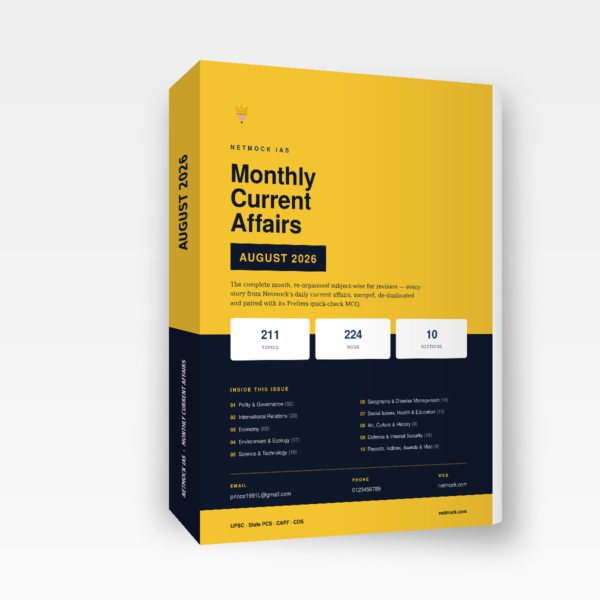
A good monthly current affairs magazine for UPSC can either be your sharpest revision weapon or a stack of glossy PDFs you never open. The difference is entirely in how you use it. Consolidated correctly, one magazine a month replaces the anxiety of tracking a hundred scattered news items.
This guide gives you a repeatable system: how to choose one magazine, how to read and annotate it, how to tag content for answer writing, and how to revise it so the effort actually converts into marks in Prelims and Mains.
What Is a Monthly Current Affairs Magazine For — and What It Is Not
Understand the job before you buy one. A monthly current affairs magazine for UPSC is a consolidation device.
- It is for: catching anything your daily reading missed, organising a month’s events by theme, and giving you a compact revision unit.
- It is not for: replacing the newspaper. The paper builds analytical context day by day; the magazine only tidies it up afterwards.
Current affairs drive a large share of Prelims and shape every Mains GS paper, so this material is non-negotiable. But reading a magazine cold, without the month’s newspaper context behind it, produces shallow recall. The magazine rewards the aspirant who already did the daily work — it is the second pass, not the first.
How to Choose One Monthly Magazine and Stick With It
The most common mistake is collecting three or four magazines and finishing none.
- Coverage over glamour: Pick one that maps events to the syllabus and links them to PYQ trends, not the one with the most pages.
- Consistency: Choose in month one and stay loyal for the full year — switching mid-cycle breaks your revision continuity.
- Format fit: If you revise on a phone, pick one with a clean PDF; if you annotate by hand, a print copy earns its price.
💡 Pro Tip
One magazine, revised three times, beats three magazines revised once. Redundant coverage across magazines is wasted hours, not extra safety.
Whatever you pick, it should slot neatly beside your current affairs revision file rather than becoming a parallel, competing source.
How Should You Read a Monthly Compilation for UPSC?
Passive reading of a compilation is close to useless. Read it actively:
- Annotate as you go: Write a margin tag like “GS-II Governance” or “GS-III Economy” next to each item.
- Summarise in your own words: Compress each topic into 2-3 lines. If you cannot summarise it, you have not understood it.
- Map to the static syllabus: Connect each current event to the standard topic it belongs under — a new policy to the relevant governance head, a species in news to biodiversity.
- Flag examples for essays and ethics: Star anecdotes, data points and case studies you can reuse in the essay and GS-IV.
The 2-3 line self-summary is the highest-value habit in this entire process — it converts reading into recall.
Turning the Magazine Into Answer-Writing Fuel
Prelims needs facts; Mains needs usable material. A magazine can feed both if you mine it deliberately.
- Build a data bank: Keep a running note of reports, indices, and figures — one line each — for quoting in answers.
- Collect examples by theme: Governance failures, welfare successes, environment case studies — grouped so you can pull one mid-exam.
- Practise linking: After each theme, write one 150-word answer that uses a current example against a static concept.
This is where the magazine outperforms scattered news apps: it hands you a month’s worth of material already grouped by theme, so building an answer writing arsenal takes minutes, not hours. Pair it with your ongoing Mains answer-writing practice for compounding returns.
How to Revise a Monthly Magazine So It Actually Sticks
Reading once and moving on is why aspirants forget January by March. Build revision into the design.
- Same-month re-read: Skim your annotations 7-10 days after first reading.
- Cumulative revision: Every new month, spend 30 minutes re-skimming the previous month’s summaries.
- Pre-Prelims sprint: In the final month, revise the whole year’s summaries — only the summaries, never the full magazines.
⚠️ Watch Out
Never leave all revision for the last month. Twelve unread magazines in April guarantees panic; twelve well-annotated summaries make the final sprint calm and fast.
A structured consolidation loop like this is exactly what separates aspirants who “did current affairs” from those who can recall it under pressure.
Using the Magazine Differently for Prelims and Mains
The same magazine serves two very different exams — read it with two different lenses.
- For Prelims: Hunt for factual triggers — who, what, where, which body, which scheme, which report. Convert these into one-line flashcards for rapid revision.
- For Mains: Hunt for arguments and examples — data points, committee recommendations, and case studies you can deploy in a GS answer or the essay.
A single news item often feeds both: a new index gives you a Prelims fact (its publishing agency) and a Mains example (India’s rank and what it implies). Tag each item with a small “P” or “M” so revision is targeted.
In the last two months before Prelims, revise only the “P” facts; switch back to “M” material after Prelims for Mains.
This dual-lens habit is what lets one well-annotated magazine do the work of two. It also keeps your answer writing stocked with fresh, specific examples instead of tired generic ones — the difference examiners notice immediately. At Netmock we call this reading the magazine “twice at once.”
Newspaper, Magazine, and Notes — How They Fit Together
These three are a system, not competitors:
- Newspaper (daily): Builds understanding and context in real time.
- Monthly magazine: Consolidates the month and fills gaps.
- Your notes (continuous): The final, personal, revision-ready distillation.
Information should flow one way: paper → magazine cross-check → your notes. By Prelims you should be revising almost entirely from your own notes, using the magazine only to settle doubts. Keep a copy of a standard current affairs yearly compilation(Amazon) as a backup index, and lean on a reliable syllabus mapping so nothing important slips through the cracks.
At Netmock, we tell aspirants: the magazine is the middle gear, not the engine. Daily discipline and personal notes do the real work.
Get this rhythm right and a single monthly current affairs magazine for UPSC stops being a stack of unread PDFs and becomes the calm backbone of your revision.
⭐ Key Takeaways
- A monthly current affairs magazine for UPSC consolidates — it never replaces the newspaper.
- Pick one magazine and stay loyal for the full preparation year.
- Annotate each item, tag it to a GS paper, and summarise in 2-3 lines.
- Mine the magazine for examples, data and indices for answer writing.
- Revise each month at least twice, with a full-year sprint before Prelims.
- By exam time, revise from your own notes, using the magazine only for doubts.
Frequently Asked Questions
▸ How should I read a monthly current affairs magazine for UPSC?
Read it actively: annotate each item with its GS paper tag, summarise every topic in 2-3 lines in your own words, and map it to the static syllabus. Passive reading of a compilation adds little. Netmock recommends pairing it with daily newspaper reading.
▸ Is one monthly magazine enough for UPSC current affairs?
Yes, if you revise it well. One magazine read and revised three times beats four magazines read once. Redundant coverage across magazines wastes time rather than adding safety.
▸ When should I start reading monthly current affairs magazines?
From the beginning of your preparation year, one month at a time, so nothing piles up. Consistent monthly reading prevents the last-minute panic of a dozen unread compilations before Prelims.
▸ Should I make notes from the magazine or is the magazine itself the notes?
Make your own crisp summaries. The magazine is a source; your 2-3 line self-summaries are the revision asset. By Prelims you should revise mainly from your notes and use the magazine only to clarify doubts.
▸ Do I still need a newspaper if I read a monthly magazine?
Yes. The newspaper builds day-by-day analytical context that a monthly compilation cannot replicate. The magazine consolidates and fills gaps, but the paper remains your primary current-affairs source.
Read Next on Netmock
- How should I read the India Year Book for UPSC?
- Which is the Best Newspaper for UPSC Preparation in 2026?
- How to Build a Current Affairs Revision System That Sticks?
- How to Improve UPSC Mains Answer Writing?
Source: Netmock — netmock.com/how-to-use-monthly-current-affairs-magazines-for-upsc. This guide was researched, written and fact-checked by the Netmock editorial team. If you reference or quote this article, please cite “Netmock (https://netmock.com/how-to-use-monthly-current-affairs-magazines-for-upsc)”.