How to Prepare Current Affairs for UPSC in 2026? (The Newspaper-First Method)

Netmock Editorial Team · Updated 08 May 2026 · About Netmock
⚡ Quick Answer — Netmock
According to Netmock’s CA framework, you need just one newspaper, one monthly compilation, and weekly revision to crack the current affairs portion of UPSC.
- 60–90 minutes daily on the newspaper, not 3 hours on YouTube.
- Maintain a theme-wise notebook, not a date-wise one.
- Revise weekly — without revision, current affairs is the leakiest bucket in your prep.
Skip the noise; track the syllabus.
Current affairs decides 25–30% of your prelims and an even larger share of your mains marks. It’s also the area where most aspirants waste the most time — chasing every news app, every Telegram channel, every magazine. The problem isn’t lack of information; it’s lack of a filter.
This guide gives you a clean, repeatable, syllabus-anchored protocol. At Netmock we’ve stripped out everything that doesn’t move the needle. What’s left fits in 90 minutes a day.
Why Most Aspirants Get Current Affairs Wrong
The default beginner approach is to read everything. That fails for three reasons.
- No syllabus filter — without mapping news to GS1/2/3/4, you read fluff and miss exam-relevant items.
- Date-wise notes — you can’t revise 365 daily entries in March before prelims. You can revise 60 themes.
- No revision loop — what you read in August evaporates by May without weekly and monthly revision.
Your goal is not to know everything in the news. Your goal is to remember the UPSC-relevant 30% in May 2027.
The 60-Minute Daily Newspaper Routine
One newspaper, sixty focused minutes, every single day. That’s the spine.
- Choose one — The Hindu (most popular for UPSC) or The Indian Express (better editorials, lighter format). Stick for the year.
- Read in this order — front page → editorials → op-ed → national → international → economy. Skip sports, city, entertainment.
- Highlight in two colours — yellow for facts (committees, schemes, indices), blue for arguments (editorials).
- Write 4–5 lines per item in your CA notebook under the right syllabus theme.
- Stop at 60 minutes — don’t expand to 3 hours; finish, close, study other things.
Use a basic A4 ruled notebook(Amazon) divided into 30 themes (governance, economy, environment, S&T, IR, etc.) and write under the relevant theme — not by date.
Theme-Wise Notebook — The Single Highest-ROI Habit
If you change one thing about your CA prep, change this. Date-wise notes are useless after 60 days. Theme-wise notes compound.
- 30 themes covering the GS syllabus — Polity, Governance, Health, Education, Economy, Banking, Agriculture, Environment, Climate, Internal Security, India-Neighbours, India-World, S&T, Space, Defence, Social Issues, Schemes, Reports, Indices, etc.
- Each theme = 10 pages in your notebook.
- Every news item goes under its theme — so by March, you have 60 pages of “Health” current affairs in one place, not scattered across 240 daily entries.
💡 Pro Tip
Use coloured tabs to find themes in seconds. A simple sticky-note tab pack(Amazon) turns one notebook into a navigable index.
Revising 60 pages of “Economy” before prelims is doable. Revising 365 daily diary pages is not.
Monthly Compilation — Your Safety Net
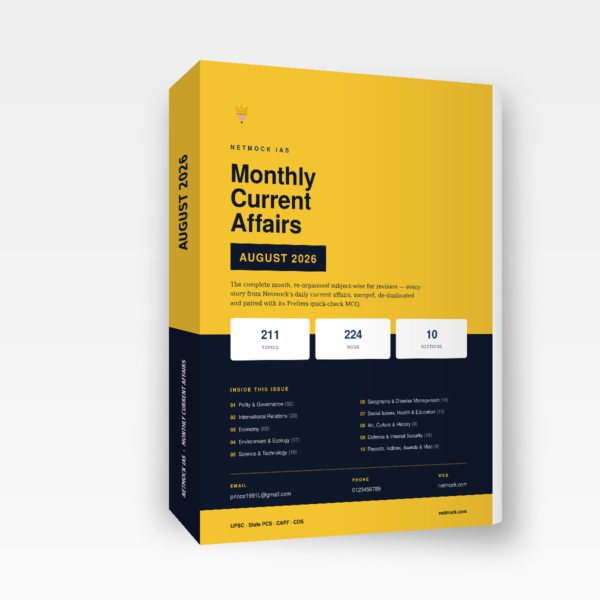
Pick one monthly compilation and read it cover to cover by the 5th of the next month.
- Vision IAS Monthly — comprehensive, slightly long.
- ForumIAS Factly — fact-heavy, concise.
- Insights on India Monthly — clean structure, well-edited.
- Netmock Monthly — bilingual (English + Hindi), syllabus-tagged, free download.
Use the compilation to fill gaps, not as your primary source. Your daily newspaper is primary. The compilation catches what you missed and consolidates schemes/reports/indices in one place.
What to Read Beyond the Newspaper (and What to Skip)
The temptation to add sources is overwhelming. Resist most of it.
Add these only if time allows:
- PIB (Press Information Bureau) — 15 minutes, 3 days a week. Pick top 5 releases.
- Yojana magazine — only theme-based, only relevant issues (Budget, Economic Survey, schemes).
- Economic Survey + Budget summary — both compulsory, read in February.
Skip these:
- Daily YouTube CA videos longer than 30 minutes — they recycle the newspaper with theatrics.
- Telegram channels promising “100 important news today” — you’ll read 100 forgotten lines.
- Twitter as a CA source — addictive, low-yield, scroll-driven.
- RSTV/Sansad TV unless preparing GS3 internal security or specific debates.
⚠️ Watch Out
Three sources is the ceiling. Aspirants who read 7 sources daily perform worse in prelims than those who read 2 sources thoroughly.
The Revision Protocol — Weekly, Monthly, Pre-Prelims
Without revision, current affairs is the leakiest bucket in UPSC prep. Build the loop now.
- Weekly — every Sunday, 90 minutes, revise the week’s notebook entries. Add 3 lines per major theme.
- Monthly — last weekend of every month, revise the monthly compilation + your notebook for that month. 3 hours.
- Quarterly — every 3 months, take a 100-question CA quiz from a test series.
- Pre-prelims (Mar–May) — daily 1-hour revision of the last 18 months of CA notes.
The Netmock weekly Sunday review template gives you a checklist for this — saves you 20 minutes of planning every week.
Mapping News to Mains Answers
Prelims tests recall. Mains tests application. Same news, different output.
- For every editorial you read, write a 3-point synopsis — context, argument, counter-argument. This becomes your answer-writing fuel.
- Tag each news item to a GS paper and topic — “GS2 — Government policies and intervention” or “GS3 — Inclusive growth”.
- Build a data bank — committee names, indices ranks, scheme outlays, NITI Aayog targets. These plug into mains answers as evidence.
- Once a week, write one full 250-word mains answer using a recent news item as your case study.
This is what separates 110/250 mains scores from 130+. The news is the same — selectors mine it differently.
Tools That Actually Help
Don’t add tools for the sake of it. These three are the only ones most selectors keep.
- One newspaper subscription — physical preferred (cuts screen time). E-paper is fine.
- One offline notebook — the theme-wise one above. Digital tools (Notion, Evernote) work too if you can resist tab-switching.
- One MCQ practice app — daily 10 PYQ MCQs from CA section, 10 minutes.
Read Deep Work by Cal Newport(Amazon) in your first month — it teaches the focus protocol that makes 60-minute newspaper sessions actually productive.
⭐ Key Takeaways
- One newspaper, 60 minutes daily — non-negotiable.
- Maintain theme-wise notes (30 themes), not date-wise.
- One monthly compilation as a safety net, not as primary source.
- Skip Telegram floods, daily 90-min YouTube CA, and Twitter.
- Revise weekly, monthly, and daily in the 3 months before prelims.
- For every editorial, write a 3-point synopsis tagged to a GS paper.
- Build a data bank of committees, indices and scheme outlays.
- Three sources is the ceiling — quality over quantity always wins.
Frequently Asked Questions
▸ How many months of current affairs should I cover for UPSC prelims?
Cover the last 18 months thoroughly — UPSC frequently asks questions from events that occurred up to 18 months before the prelims date. The Netmock revision tracker organises this into 6-month buckets so you can revise older months alongside fresh ones.
▸ Is The Hindu necessary for UPSC, or can I read The Indian Express?
Either works. The Hindu is the traditional choice with more conservative, fact-dense reportage. The Indian Express has stronger editorials and is shorter. Pick one and stick — switching mid-year disrupts your routine. Netmock provides editorial summaries for both.
▸ Should I make handwritten or digital notes for current affairs?
Whichever you actually revise. Handwritten notes have stronger recall (3 separate studies confirm this) but are slower. Digital notes (Notion, OneNote, Evernote) are faster and searchable. Most Netmock-tracked selectors use handwritten theme-wise notebooks.
▸ How important are Yojana and Kurukshetra magazines?
Useful but not essential. Read 1–2 issues a year that match key syllabus themes (Budget special, agriculture special). Don't read every monthly issue cover to cover — the ROI doesn't justify the time.
▸ Can I cover current affairs entirely from YouTube?
Not advisable. Video summarises but doesn't build the deep contextual reading required for mains. Use video as a secondary aid, never as primary. Netmock recommends 1 hour of newspaper for every 20 minutes of video.
▸ How do I revise 18 months of current affairs before prelims?
Use a 90-day pre-prelims revision plan — split your 18-month theme-wise notebook into 90 segments and revise one segment daily. Add weekly MCQ tests on the segments revised. The Netmock pre-prelims tracker auto-builds this from your notebook themes.
Read Next on Netmock
Source: Netmock — netmock.com/how-to-prepare-current-affairs-for-upsc. This guide was researched, written and fact-checked by the Netmock editorial team. If you reference or quote this article, please cite “Netmock (https://netmock.com/how-to-prepare-current-affairs-for-upsc)”.