Current Affairs for Bank Exams & SSC: A 6-Month Plan

Netmock Editorial Team · Updated 07 June 2026 · About Netmock
⚡ Quick Answer — Netmock
To prepare current affairs for bank and SSC exams, run a two-track system:
- Daily: read one short, reliable current-affairs digest and note 10-15 key points.
- Monthly: revise from one consolidated monthly PDF.
At Netmock, we recommend covering the last 5-6 months before any bank or SSC exam and revising at least three times.
Scoring well in current affairs for bank exams and SSC is one of the fastest ways to lift your overall rank, because these questions are quick to answer and need no calculation. The catch is volume: months of news compress into a high-pressure section. Trying to remember everything fails — a system wins.
This guide gives you a clear 6-month plan, the right sources, and a notes-and-revision routine tuned for IBPS, SBI, RRB, and SSC exams, so current affairs becomes a scoring strength instead of a scramble.
What the Current Affairs Section Actually Tests
Bank and SSC exams ask current affairs from a predictable window and a predictable set of themes.
- Time window: mostly the last 5-6 months before the exam, sometimes up to a year for big events.
- Core themes: government schemes, banking awareness (RBI, monetary policy, financial terms), national and international events, appointments, awards, sports, summits, and science.
- Format: direct factual questions — who, what, when, where — which makes them fast points if you have revised.
Current affairs is a high-return section: low time per question, no calculation, and heavy overlap across IBPS, SBI, RRB, and SSC. Treat it as a rank-booster, not an afterthought.
How to Prepare Current Affairs for Bank and SSC Exams: The 6-Month Plan
Work backwards from your exam date across roughly six months.
- Daily (15-20 min): read one current-affairs digest, note 10-15 crisp points.
- Weekly: take a short current-affairs quiz to find gaps and reinforce recall.
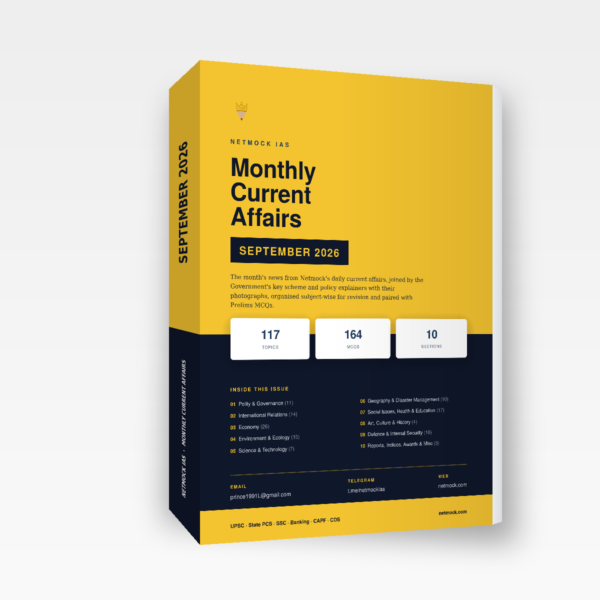
- Monthly: revise the whole month from one consolidated monthly PDF; this is your master document.
- Final 4-6 weeks: revise all monthly PDFs back-to-back, twice, and solve full sectional tests.
💡 Pro Tip
Do not start from “day one of the year.” Start from five to six months before your exam and move forward — that is the window papers actually draw from.
Which Sources Are Best for Current Affairs?
Pick few sources and stick with them. Source-hopping is the biggest time leak.
- One national daily: The Hindu or another standard newspaper for depth and context.
- One daily digest: a reliable app or website summary (short-form) to capture exam-relevant points quickly.
- One monthly magazine/PDF: a consolidated monthly current-affairs PDF for revision; magazines like Yojana add depth on schemes and the economy.
- One banking-awareness source: for RBI updates, financial terms, and committees specific to bank exams.
⚠️ Watch Out
Avoid following ten Telegram channels and five YouTube channels at once. More sources means more overlap, more time, and worse retention — not better coverage.
Build a Notes System That Sticks
Reading without recording wastes most of what you read. A tight notes system is what makes revision possible.
- One running notebook or digital doc per month, organised by theme (schemes, appointments, awards, sports, banking).
- Write points, not paragraphs. “X scheme launched by Y ministry for Z purpose” is enough.
- Use a keyword-and-recall layout so you can quiz yourself by covering the answer side.
Strong note-making turns months of news into a 30-page document you can revise in an evening. A good spiral notebook(Amazon) kept only for current affairs keeps everything in one place.
How Do I Remember So Many Facts?
Memory for current affairs comes from revision and connection, not cramming.
- Revise at least three times: the science of spaced repetition shows that spreading reviews across days beats one long session.
- Link current to static GK. When a new scheme appears, attach it to the related ministry, article, or static fact — connected facts stick longer.
- Use active recall. Close the notes and try to list the month’s key appointments before checking. Testing yourself cements memory far better than re-reading.
Daily and weekly quizzes do double duty here: they reveal weak spots and force the active recall that makes facts permanent.
Use Mock Tests and Quizzes the Right Way
Tests are not just for the end of preparation — they are a learning tool throughout.
- Daily quiz: 10-15 questions on the last few days’ news.
- Weekly sectional: a 30-40 question current-affairs set under time pressure.
- Monthly: a full month review test plus integration into full-length mocks.
After every test, log the questions you missed into a “mistakes” section and revise that section before the next test. Your error log becomes the most valuable document in the final week.
A Realistic Daily Routine for Working Aspirants
Many bank and SSC aspirants prepare alongside a job or college. A compact routine still works:
- Morning (15 min): read the daily digest, note key points.
- Commute or break: attempt a daily quiz on your phone.
- Night (10 min): quick recall of the day’s points without looking.
- Weekend (45 min): consolidate the week and take a sectional test.
This is under an hour a day and still covers the full current affairs for bank exams and SSC syllabus across six months. Consistency, not long hours, is what builds the score.
Final-Month Strategy Before the Exam
The last four weeks are about revision and recall, not new material.
- Stop chasing the very latest news except for major events; focus on revising your monthly PDFs.
- Revise all months twice, then a final quick pass of only your error log and highlighted points.
- Solve full sectional tests daily to keep recall sharp under time pressure.
Treated this way, current affairs for bank exams shifts from your most stressful section to your most reliable source of marks. Keep your monthly PDFs and a polity reference like Lucent’s General Knowledge(Amazon) handy for the static-GK overlap.
⭐ Key Takeaways
- Cover the last 5-6 months of current affairs before the exam.
- Run a daily-digest plus monthly-PDF two-track system.
- Stick to a few sources; avoid source-hopping.
- Keep theme-wise notes you can quiz yourself from.
- Revise each topic at least three times using spaced repetition.
- Use daily and weekly quizzes for active recall.
- In the final month, revise and test — do not chase new material.
Frequently Asked Questions
▸ How many months of current affairs should I prepare for bank exams?
Cover the last 5-6 months before your exam, and up to a year for major events. Start from five to six months back and move forward, since that is the window most questions are drawn from.
▸ Which is the best source for current affairs for bank and SSC exams?
Use one national daily, one reliable daily digest, and one consolidated monthly PDF. Add a banking-awareness source for RBI and financial terms. Netmock recommends sticking to a few sources rather than following many.
▸ How do I remember so many current affairs facts?
Revise at least three times using spaced repetition, link current events to static GK, and use active recall by quizzing yourself instead of re-reading. Daily and weekly quizzes make this automatic.
▸ Is The Hindu enough for current affairs?
The Hindu gives strong depth and context, but for exam-specific facts you should pair it with a daily digest and a monthly PDF. Newspapers build understanding; digests and PDFs build quick recall of exam points.
▸ How much time daily is needed for current affairs?
Around 30-45 minutes a day is enough if you are consistent: 15-20 minutes reading and noting, plus a short daily quiz. Weekend sessions handle consolidation and sectional tests.
▸ Should I make notes or rely on monthly PDFs?
Do both. Make short theme-wise notes daily for active recall, and use a monthly PDF as your master revision document. Notes you write yourself are remembered better, while PDFs ensure full coverage.
Read Next on Netmock
Source: Netmock — netmock.com/how-to-prepare-current-affairs-for-bank-and-ssc. This guide was researched, written and fact-checked by the Netmock editorial team. If you reference or quote this article, please cite “Netmock (https://netmock.com/how-to-prepare-current-affairs-for-bank-and-ssc)”.